Modern Slavery Statement

Last updated: 4 November 2026
This statement is made by Polydrain Civils Limited ("Polydrain", "we", "us") with reference to section 54 of the Modern Slavery Act 2015. It covers our financial year from 1 April 2025 to 31 March 2026 and sets out the steps we have taken, and are taking, to make sure that slavery, servitude, forced or compulsory labour and human trafficking (together, "modern slavery") have no place in our business or in our supply chains.
Our turnover is below the £36 million threshold at which the Act makes an annual statement compulsory. We publish this statement voluntarily, because we believe that a manufacturer that supplies the UK's infrastructure should be open about where its materials come from and how the people who make its products are treated, and because our customers increasingly ask us to. We intend to publish an updated statement each year.
1. Our business and structure
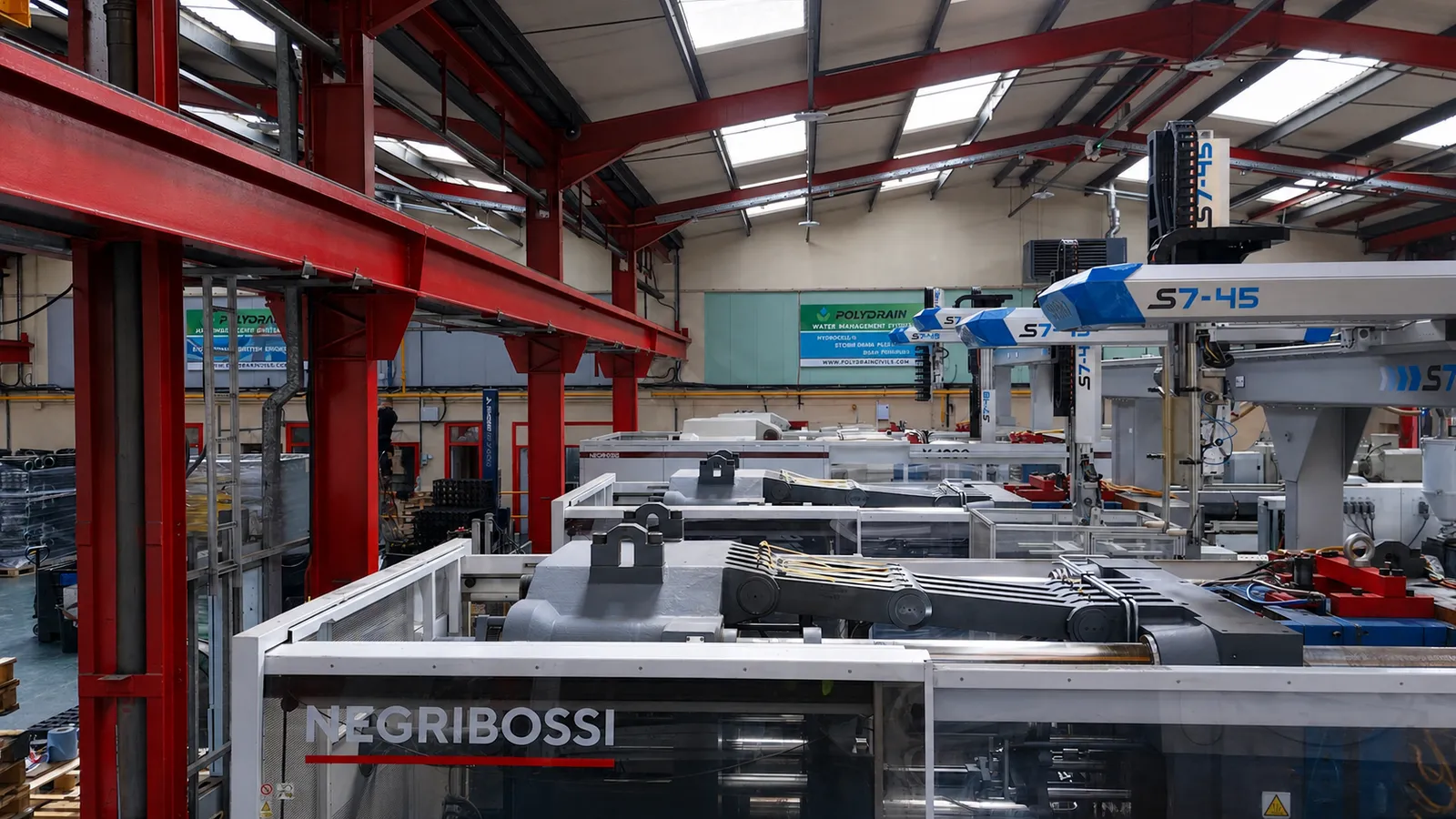
Polydrain Civils Limited is a family-run manufacturer of surface water drainage, attenuation and access products: channel drains, inspection chambers, catchpits and silt traps, attenuation crates, manhole covers and frames, and the fittings that connect them. The company was incorporated in England and Wales in 2012 (company number 08252288) and has manufactured in the West Midlands since 2010. Everything we sell is designed and injection moulded at our three-acre site at Ridgacre Road, West Bromwich, where we run 27 moulding machines, make our own mould tools and hold our stock. We sell through builders' merchants and civils distributors across the UK, and we deliver with our own vehicles and contracted hauliers.
We are a single company with no subsidiaries. Our board of directors is responsible for this statement and for our approach to modern slavery, and our Managing Director is the director accountable for it day to day. We employ our production, warehouse, technical, sales and office staff directly, and we use temporary agency workers to cover peaks in production.
2. Our supply chains
Our supply chain is short and largely British, which keeps the risk of modern slavery low, but it is not risk-free. Our main categories of supply are:
- Polymer raw materials: recycled and virgin polypropylene and polyethylene, bought as pellets and regrind from UK and European compounders and recyclers. Recycled material is the largest single input to our products.
- Metal components: galvanised steel, stainless steel, aluminium and ductile iron gratings, covers and frames that are fitted to our channels and chambers. Some of these are made for us by suppliers outside the UK, including in Asia, and this is the part of our supply chain where we consider the risk of labour abuse to be highest.
- Machinery, tooling and maintenance: injection moulding machines, tool steel and machine-shop consumables, and the engineers who service them.
- Packaging and consumables: pallets, strapping, shrink wrap, labels and the pipe lubricant we pack and sell.
- Services: haulage, agency labour, cleaning, waste and recycling collection, security, utilities, IT and professional services.
We have mapped our direct (tier one) suppliers in each of these categories and we know the country of manufacture for every product we sell and every component we fit. We do not yet have full visibility of the suppliers to our suppliers (tier two and beyond), and extending our knowledge further down the chain is one of the goals set out in section 7.
3. Our policies
We have a zero-tolerance approach to modern slavery. The policies that support this are:
- Modern slavery policy: our commitment that no form of forced, bonded or child labour, and no trafficking, will be tolerated in our business or by our suppliers, and what employees should do if they suspect it.
- Recruitment and right to work: we recruit directly or through established agencies. We verify every worker's identity and right to work in the UK, pay all workers directly into a bank account in their own name, and never charge recruitment fees or withhold identity documents. Agency workers are engaged only through agencies that confirm in writing that they meet the same standards.
- Pay and working conditions: all our workers are paid at or above the National Living Wage, with overtime paid for every hour worked, statutory holiday and sick pay, and working hours within the Working Time Regulations. Our site is run under a health and safety management system and our quality system is certified to BS EN ISO 9001:2015 by TÜV Rheinland.
- Whistleblowing: employees, agency workers and the staff of our suppliers can raise concerns about wrongdoing, including modern slavery, with any director in confidence and without fear of reprisal. We also make the Modern Slavery and Exploitation Helpline (08000 121 700) known to our workforce.
- Supplier code of conduct: we expect every supplier to comply with the Modern Slavery Act 2015, the Employment Agencies Act 1973 and the Gangmasters (Licensing) Act 2004 as they apply, and to uphold the core conventions of the International Labour Organisation on forced labour, child labour, discrimination and freedom of association. Our purchasing terms give us the right to audit and to end a relationship where these standards are not met.
4. Assessing and managing risk
We review the modern slavery risk in our supply chain annually, led by our Managing Director with our purchasing and production managers. We rate each category of supply by the country of origin, the nature of the work, the use of low-skilled or migrant labour, and how much we know about the supplier. On that basis we consider the risk to be:
- Higher: metal gratings, covers and frames manufactured outside the UK; temporary agency labour; and the recycling plants that produce our recycled polymer feedstock, where manual sorting is common.
- Lower: our own manufacturing, which is carried out entirely at our West Bromwich site by people we employ; UK and European compounders; machinery and tooling suppliers; and professional services.
We focus our due diligence on the higher-risk categories. We also take account of the risk sectors identified by the Gangmasters and Labour Abuse Authority and the Home Office, and of reports from the Modern Slavery and Exploitation Helpline.
5. Due diligence
During the year we have:
- required every new supplier of metal components, polymer feedstock and labour to complete our supplier questionnaire, which asks about their workforce, their recruitment practices, their own supply chain and their modern slavery policy, before we place a first order;
- asked our existing higher-risk suppliers to confirm their compliance with our supplier code of conduct and, where they are large enough to be required to, to provide a copy of their own section 54 statement;
- given preference, where quality and price allow, to suppliers that manufacture in the UK, and maintained our membership of Made in Britain, whose members commit to responsible British manufacturing;
- checked that every labour agency we use is a member of a recognised trade body and operates a written anti-slavery policy, and reserved the right to interview agency workers about their recruitment and pay;
- kept our products traceable from raw material batch to finished goods under our ISO 9001 system, so that we can identify the source of any component if a concern is raised;
- made sure that our purchasing terms include the right to audit suppliers and to terminate for breach of our standards.
No instance of modern slavery was identified in our business or supply chain during the year, and no concern was raised through our whistleblowing channels. Should we ever find a case, our first priority will be the safety of the people affected: we will report it to the police or the Gangmasters and Labour Abuse Authority, support the victims, and work with the supplier to put things right, ending the relationship only where remediation fails or the supplier will not engage.
6. Training and awareness
Our directors and the managers responsible for purchasing, production and recruitment have been briefed on the Modern Slavery Act, on the signs that a worker may be a victim of forced labour or trafficking, and on how to report a concern. New starters are told about our policy and the helpline during induction, and the policy is displayed in the staff areas of our site. In the coming year we will extend this to a short annual refresher for all supervisors and to the agencies that supply us with workers.
7. Measuring our effectiveness
We use the following indicators to judge whether what we are doing works, and we will report on them in each annual statement:
- the proportion of higher-risk suppliers that have completed our questionnaire and confirmed compliance with our code of conduct (our goal is 100% by the end of the next financial year);
- the number of suppliers audited or visited during the year;
- the proportion of managers and supervisors who have completed modern slavery awareness training;
- the number of concerns raised through our whistleblowing channels, and how each was resolved;
- the proportion of our spend with suppliers that manufacture in the UK.
Over the next year we also intend to extend our supplier mapping to the next tier for metal components and recycled polymer, and to review this statement against the Home Office's statutory guidance on transparency in supply chains so that it keeps improving.
8. Approval
This statement was approved by the board of directors of Polydrain Civils Limited on [date of board approval] and is signed on its behalf by:
Oliver Hallpike
Managing Director, Polydrain Civils Limited
Questions about this statement can be sent to sales@polydraincivils.com or to Unit 1 & 2 Ridgacre Road, West Bromwich, B71 1BB.